

Table of Contents
Issue 3 of 4 with 12 Weeks Left. Cost seg, REPS, short term rentals, and the wall most investors hit.
Welcome back to The Ledger. Issue 1 covered the new tax law. Issue 2 was for business owners. This week is for the real estate crowd: people who own rentals, and people who invest as LPs in other people’s deals.
If that is you, this is the issue that can change your 2026 tax bill the most. Let’s go.
Why the government pays you to own real estate
The tax code is about 70,000 pages long. Most people think it is a trap. It is not. The biggest way the goverment influences the economy is through tax policy. They tell you what they want done, and provide a payment for doing them.
Real estate does 3 of those jobs:
-
Housing. You give people a place to live. Those people go to work and pay tax.
-
Jobs. You build space for businesses. They grow, hire, and pay payroll tax.
-
Infrastructure. You give space to clinics, schools, and research.
So the government pays you back in deductions and tax credits. The deductions are the payment. They are not a loophole.
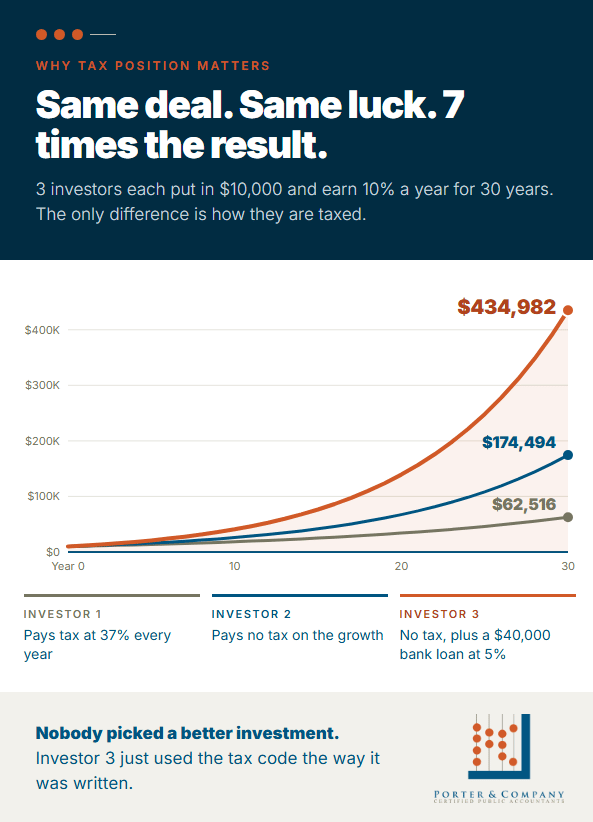
Here is why that matters. Picture 3 investors. Each puts in $10,000. Each earns 10% a year for 30 years. Same deal. Same luck.

Investor 3 ends up with about 7 times what Investor 1 has. Nobody picked a better investment. They picked a better tax position.
Real estate is one of the few places where you can get both: deductions that shelter the growth, and a bank that helps you buy more of it. The rest of this issue shows you how.
The engine: cost seg plus 100% bonus
Normally, a rental building gets written off slowly. The IRS says a residential building lasts 27.5 years, so you deduct a small slice each year.
But a building is not one thing. It is carpet, cabinets, lights, fences, parking lots, and landscaping. Those parts do not last 27.5 years. A cost segregation study breaks the building into its parts so the short life pieces can be written off much faster.
Then comes bonus depreciation. It lets you write off those short life parts all at once, in year 1. It was dying: 80% in 2023, 60% in 2024, 40% in 2025, headed to zero. Last July, the One Big Beautiful Bill brought it back to 100%, and made it permanent. No step down. No deadline to race.
The fine print: the property has to be acquired after January 19, 2025. For new construction, the build has to start after that date. If you signed a binding contract before then, the old lower rate still applies. Check your dates with us before you count on it.
A real example. Here is a 40 townhome project in Grand Prairie we used in a recent talk with the client group
-
Total cost: $14,000,000
-
Land (never depreciable): $4,500,000
-
Building you can depreciate: $9,500,000
|
Method |
Year 1 deduction |
Year 1 tax savings at 37% |
|---|---|---|
|
Standard 27.5 year |
$345,000 |
$128,000 |
|
Cost seg, no bonus |
$770,000 |
$285,000 |
|
Cost seg plus 100% bonus |
$2,650,000 |
$980,500 |
Same building. Same law. 3 very different tax bills.
Here is the part most people miss. You depreciate the building, not your down payment. The owners put in $3,500,000. The bank put in $10,500,000. But the deduction is based on the whole building. So that $980,500 in tax savings came from a $3,500,000 check.
Now shrink it to your size.
|
|
3% LP stake in the deal above |
Buy a $500,000 rental |
|---|---|---|
|
Cash you put in |
$100,000 |
$125,000 |
|
Year 1 depreciation |
$75,714 |
$111,600 |
|
Tax savings at 37% |
$28,014 |
$41,300 |
|
Real cost after tax savings |
$71,986 |
$83,700 |
The deduction pays for part of your own way in. That is true whether you own the property or you are a passive LP.
Case study only. This is not an offer to sell securities. Your savings depend on your own return.
So why doesn’t everyone do this? Because of a wall. Let’s talk about it.
The passive wall, and the key that opens it
The IRS sorts every dollar you make into 3 buckets:
-
Active. What you do all day. Your W2, your business, your medical practice.
-
Portfolio. What your money does. Stock gains, bitcoin, interest, dividends.
-
Passive. What you own but do not run. Rentals, deals you invest in as an LP.
Real estate is passive by default. And here is the problem: passive losses cannot cross over to the other buckets. That $2,650,000 deduction cannot touch your salary, your business income, or your stock gains. It hits a wall.
Good news for LPs: a blocked loss is not a lost loss. It can still wipe out passive income from your other deals. Whatever is left carries forward. And when you sell the property, the stuck losses get released. So LP losses still have real value. They just may not help this year’s W2.
The key: Real Estate Professional status
If you qualify as a Real Estate Professional (REPS), your rental losses stop being passive. The wall comes down. You have to pass both tests:
-
750 hours a year in real estate businesses where you materially participate. That is about 15 hours a week.
-
More than half of all your work hours for the year go to real estate. This is the test that stops most people.
The second test is the killer. A doctor working 50 hours a week? No. A CPA working 45 hours a week? No. An engineer with a 40 hour W2 job and 4 rentals? Still no.
Who can qualify? A spouse who does not have another job. Only 1 spouse needs to pass both tests, and the whole household gets the benefit on a joint return.

The 750 hour tracker
If you claim REPS and the IRS asks, a calendar you built after the fact will not hold up. Log it as you go.
|
Hours that count |
Hours that do not |
|---|---|
|
Finding and looking at properties |
Reading about real estate |
|
Negotiating and closing |
Seminars and courses |
|
Managing tenants and leases |
Investor research |
|
Repairs, turns, and upkeep |
Work your property manager does |
|
Bookkeeping for the properties |
|
Want our free 750 hour tracker? Get our tracker – Prove 750 . Print it or keep it in your phone.
One more thing: REPS status alone is not enough. You also have to materially participate in the rentals themselves. We help clients set that up the right way.
Door 2: the short term rental
Can’t pass the REPS tests? There is a second door.
If the average guest stay is 7 days or less, the IRS stops treating the property as a rental. It treats it as a business. That means REPS is not required.
What you get: the same cost seg and bonus write offs, and they can offset your W2 and your capital gains. No 750 hour test. No “more than half your work time” test.
What it costs: you have to materially participate. The most common ways to pass:
-
You spend at least 100 hours on it during the year, and more than anyone else (including your cleaner and your manager), or
-
You spend 500 hours or more on it.
That means you handle the guests, the cleaners, the turnovers, and the reviews. If you hand it all to a full service manager, you likely fail the test, and the losses go back behind the wall.
Our honest take: this is a real business, not a side hustle. It works great for some people. For a busy family with 2 full time jobs, it is usually more work than it is worth. Worth knowing. Not for everyone.
And just like REPS: track your hours as you go.

None of this works without a plan
Cost seg, bonus, REPS, STR. Every one of these has to be set up before December 31. A tax return only reports what already happened. By April, it is too late to change it.
That is what a tax plan is for. We look at your whole picture, your W2, your business, your deals, and figure out which doors are open to you and which ones are not.
Client story: A married couple earned over $861k a year in combined W2 wages and paid $248k in federal tax. We helped them buy a single family home to run as a short term rental. Accelerated depreciation created an $83k paper loss in year 1, worth $31k in tax savings. All in planning and year 1 savings: $43k.
Most of our clients only use our Compliance tier: we file the return and stand behind it. But there are 2 more levels:
-
Clarity. Everything in Compliance, plus tax projections so you see the bill coming, and 2 planning meetings a year.
-
Vision. Our most complete planning. A custom tax strategy built around you, with quarterly meetings.
If you own rentals or invest in deals, Clarity or Vision is where the real savings live. Book a free 30 minute call . We look at your actual return
Giveaway update: 18 people are in
18 readers have qualified so far for our drawing for a free Vision tax plan. Every qualified referral is another entry.
Know someone who owns rentals or invests as an LP? This issue is a great one to send them –
We announce the winner in late October.
What’s Coming next – 4 Part Tax Planning Series
Every Saturday for 4 weeks, you’ll get 1 part of the playbook:
-
Part 1 (Sept 26th): Why these 14 weeks matter, and what changed in the tax law
-
Part 2 (Last week): Business owners. How to build a tax smart business
-
Part 3 (Today): Real estate investors and LPs. Depreciation, rentals, and K1s
-
Part 4 (Next Week): Big income years. Roth conversions, charity, and what a real tax plan looks like
Each one gives you real moves you can use. No fluff.
Office Hours coming up: protect what you built
You spent this issue learning how to build wealth and keep more of it. Next week, we ask a harder question: if something happened to you or a key partner tomorrow, would your business and your family be ready?
October is Life Insurance Awareness Month. Issue 4 drops Saturday, October 17, and it leads into a free webinar 2 days later.
Life Insurance Awareness Month: Protect Your Business, Your Family, and Your Legacy
-
When: Monday, October 19, 2026, 2:00 to 3:00 PM CST
-
Where: Zoom
-
Presenter: Emtiaz Sultanali, Licensed Financial Professional
You will learn how life insurance can help with:
-
Business continuation. Keep the business running if an owner passes away.
-
Key person protection. Protect your company from losing someone it can’t easily replace.
-
Buy sell funding. Make sure partners have the cash to buy out an owner’s share.
-
Estate planning. Pass on more of what you built to the people you love.
Spots are limited. Register to watch live or catch recording
Until next week. Your success is our success. Thanks for reading !
Vince & the P&C Team


Leave a Reply